For an iguana owner, there is nothing quite as striking as the prehistoric majesty of a healthy Green Iguana. With their vibrant scales, alert eyes, and powerful tails, they are the crown jewels of the reptile world. But beneath that stoic, dragon-like exterior, a silent killer is often at work.
Metabolic Bone Disease (MBD) is the most common—and most preventable—illness in captive iguanas. Because reptiles are masters at hiding weakness to avoid predators, an iguana can appear “fine” while its skeletal system is literally dissolving. By the time the symptoms are obvious to a casual observer, the disease is often advanced.
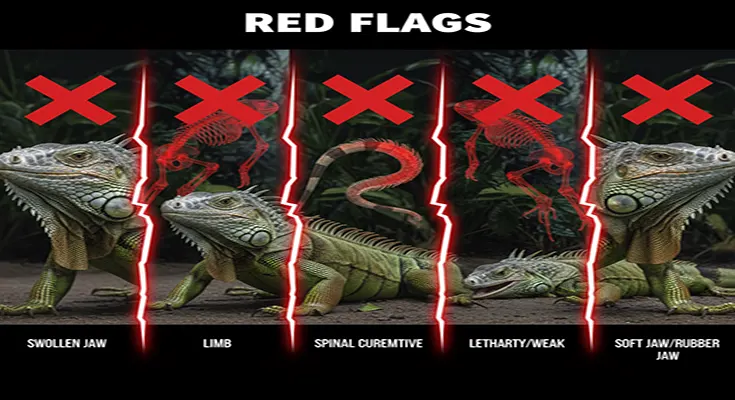
If you want to ensure your iguana lives to see its fifteenth birthday, you must learn to read the subtle language of its body. Here are five red flags for MBD that you simply cannot afford to ignore.
Understanding the Culprit: What is MBD?
In short, MBD is a total breakdown of the body’s calcium regulation. An iguana needs three things to build bone: Calcium, Vitamin D3, and UVB radiation.
When an iguana doesn’t get enough UVB light, it cannot produce Vitamin D3. Without D3, it cannot absorb calcium from its food. The body, desperate to keep the heart and muscles working (which require calcium), begins to “mine” the mineral from the iguana’s own bones. The result is a skeleton that becomes soft, brittle, and prone to horrific deformities.
Red Flag #1: The “Rubber Jaw” (Softened Mandible)
One of the earliest clinical signs of MBD is a change in the structure of the face. In a healthy iguana, the jaw is firm and sits squarely. As calcium is leached from the skull, the jawbone loses its rigidity.
- What to look for: You might notice the lower jaw appears slightly “receded” or looks swollen. In advanced cases, the jaw becomes flexible—hence the term “rubber jaw.”
- The subtle sign: Your iguana may start having trouble “zipping” its mouth shut completely, or you might see the pink tissue of the gums exposed more than usual.
Red Flag #2: “Popeye” Legs (Swollen Limbs)
At first glance, an iguana with MBD might look “buff” or well-muscled. Owners often mistake swollen limbs for healthy growth. However, this isn’t muscle; it is fibrous osteodystrophy.
As the leg bones become thin and weak, the body attempts to reinforce them by wrapping them in layers of fibrous connective tissue. This makes the legs look unnaturally thick or “puffy” compared to the rest of the body.
- What to look for: Look at the “thighs” and forearms. If they look like swollen sausages and feel firm but slightly springy rather than muscular, your iguana is likely in the middle of a calcium crisis.
Red Flag #3: The “Army Crawl” and Tremors
Because MBD affects the nervous system and muscle contractions (which rely on calcium ions), you will see a decline in mobility.
- Weakness: A healthy iguana should be able to lift its chest and belly off the ground when it walks. If your pet is “dragging” its body or using its front legs to pull itself along while the back legs lag behind, its bones are likely too weak to support its weight.
- Twitching: Look for “fasciculations”—tiny, involuntary muscle tremors in the toes or legs. This is a sign of extreme calcium deficiency in the bloodstream and is often a precursor to seizures.
Red Flag #4: Bumps and “Kinks” in the Spine or Tail
As the bones soften, the weight of the iguana’s own body and the pull of its muscles can cause the skeleton to collapse or fold.
- The Spine: Look for a “hunch” or a sudden dip in the back.
- The Tail: A healthy tail should be a straight, powerful taper. If you notice a “kink” or a hard “V” shape in the tail that wasn’t there before, it indicates a spontaneous fracture that has attempted to heal in a deformed position.
Red Flag #5: Chronic Constipation (Anorexia and Cloacal Issues)
MBD doesn’t just affect the bones you can see; it affects the ones you can’t. The pelvis can become deformed, narrowing the passage through which waste must pass. Furthermore, the smooth muscles of the gut require calcium to contract (peristalsis).
- The Sign: If your iguana is eating but not passing waste, or if it has stopped eating entirely, it may be due to the physical pain of a collapsing skeleton or the inability of the gut to move food.
Prevention: The “Big Three” Requirements
If you catch MBD early, it is often reversible. If you want to prevent it, you must adhere to this blueprint:
| Requirement | Why it Matters | How to Provide It |
| High-Output UVB | Essential for D3 synthesis. | Use a T5 HO Linear Tube (10.0 or 12.0). Change it every 6 months. |
| Calcium:Phosphorus Ratio | Too much phosphorus blocks calcium. | Feed a 2:1 ratio. Mainstays: Collard greens, mustard greens, turnip greens. |
| Proper Heat | Digestion stops if it’s too cold. | Basking spot of $35-38^{\circ}\text{C}$ ($95-100^{\circ}\text{F}$). |
What to Do if You See These Flags
- See an Exotic Vet Immediately: This is not a “wait and see” situation. A vet can administer liquid calcium injections and Vitamin D3 “boosters” that can save the animal’s life.
- Audit Your Lighting: Most MBD cases are caused by old UVB bulbs or bulbs that are too far away from the basking spot. Ensure the bulb is within 10–12 inches of the iguana.
- Check Your Supplements: Are you dusting your greens with Calcium + D3 powder? If not, start today.
Your iguana isn’t “lazy,” and it isn’t “just getting old.” If it’s dragging its legs, twitching, or sporting a swollen jaw, it is screaming for help in the only way it knows how. Metabolic Bone Disease is a painful, slow-motion disaster, but it is one that you have the power to stop.
By being an observant owner and providing the “Big Three” (UVB, Calcium, Heat), you can ensure your green dragon stays strong, straight, and healthy for years to come.