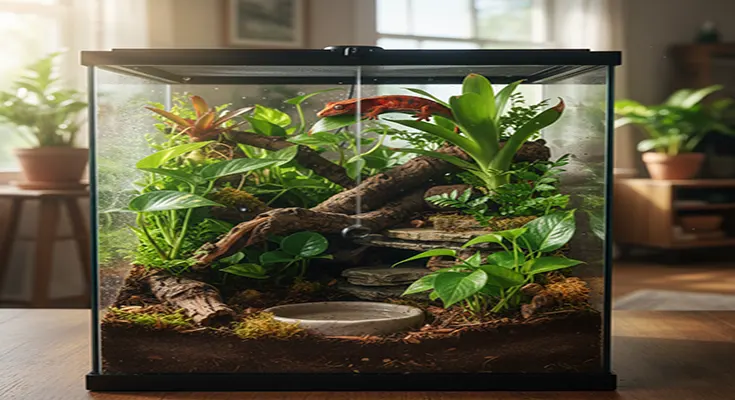
For years, the standard for keeping a Crested Gecko (Correlophus ciliatus) was a simple glass tank with paper towel bedding and a few plastic plants. While functional, these “sterile” setups require constant manual cleaning and offer little in the way of natural enrichment.
Enter the Bioactive Vivarium.
A bioactive home is a self-sustaining ecosystem where live plants, beneficial fungi, and a “cleanup crew” of tiny invertebrates work together to break down waste. Not only are these enclosures visually stunning—transforming a pet tank into a living piece of tropical art—but they also create a healthier, more humid, and more stimulating environment for your gecko. Best of all? The tank cleans itself.
Here is your master blueprint for designing the ultimate bioactive “nature in a box.”
Phase 1: The Foundation (The Drainage Layer)
In a bioactive setup, you are watering live plants and misting for humidity. Without a way to manage that water, the soil will become waterlogged, rotting the roots of your plants and creating a breeding ground for harmful bacteria.
- The Materials: Use an inch or two of expanded clay balls (Hydroton) or specialized drainage mesh.
- The Barrier: Place a fine plastic mesh (substrate barrier) over the clay balls. This prevents the soil from falling into the drainage layer while allowing excess water to pass through.
Phase 2: The “Living” Soil (Substrate)
You cannot use standard potting soil, which often contains fertilizers and perlite that can be harmful to geckos. You need a “ABG Mix” (Atlanta Botanical Gardens) or a similar tropical blend.
- The Recipe: A mix of tree fern fiber, orchid bark, sphagnum moss, and charcoal.
- The Purpose: This soil is designed to hold moisture without compacting, allowing plant roots to breathe and providing a home for your cleanup crew.
Phase 3: The Hardscape (Skeleton of the Forest)
Crested Geckos are arboreal; they spend their lives in the canopy. Before adding plants, you must build the “climbing structure.”
- Cork Bark: This is the gold standard. It is mold-resistant and has a rough texture that geckos love for climbing and shedding.
- Ghost Wood or Mopani: These provide sturdy horizontal perches.
- The Background: Many keepers use expanding foam covered in silicone and coco-fiber to create a 3D cliff face. This adds vertical surface area and allows you to “plant” air plants directly onto the walls.
Phase 4: Selecting the Flora (The Canopy)
Not every tropical plant is “gecko-proof.” You need sturdy plants that can support the weight of a jumping lizard.
- Snake Plants (Sansevieria): Indestructible and provide excellent vertical perches.
- Pothos: The classic “jungle” vine. It grows fast and helps suck up excess nitrates from gecko waste.
- Bromeliads: These are essential. The “tanks” (the center of the plant) hold water, providing a natural drinking station and a humid hiding spot.
- Lemon Button Ferns: Great for adding texture and cover at the lower levels of the tank.
Phase 5: The Cleanup Crew (The “Bio” in Bioactive)
This is the secret sauce. You are introducing a micro-ecosystem of “detritivores” that eat decaying plant matter and gecko droppings.
- Isopods (Springtails and Woodlice): Small crustaceans (like “Roly-Polies”) that live in the soil.
- Springtails: Tiny, white insects that eat mold and fungi.
- Leaf Litter: You must provide a layer of dried oak or magnolia leaves on top of the soil. This acts as the primary food source and “apartment complex” for your cleanup crew.
Phase 6: Lighting and Climate
While Crested Geckos don’t need high-intensity heat, your plants need light to survive.
- Full Spectrum LED: Use a plant-growth LED (6500K spectrum) to keep your moss and vines vibrant.
- The Temperature Sweet Spot: Keep the tank between $22-25^{\circ}\text{C}$ ($72-78^{\circ}\text{F}$).
- Humidity: Aim for a “dry down” cycle. Mist heavily at night to reach 80-90% humidity, then allow it to drop to 50% during the day. This prevents mold and mimics the natural cycle of a rainforest.
Summary: The Bioactive Advantage
| Feature | Sterile Setup | Bioactive Setup |
| Cleaning | Weekly deep-clean of substrate. | Never change substrate; “Spot clean” glass only. |
| Humidity | Fluctuates wildly. | Stabilized by live plants and moss. |
| Odors | Can smell like waste/plastic. | Smells like a fresh forest after rain. |
| Aesthetics | Functional/Artificial. | A living piece of home decor. |
Maintenance: What Do You Actually Have to Do?
“Self-cleaning” doesn’t mean “zero effort.” Your role changes from “Janitor” to “Gardener.”
- Trim the Plants: In a healthy tank, Pothos will take over. Prune them back once a month to keep the climbing space open.
- Wipe the Glass: Your gecko will still leave “nose smudges” on the glass. Use a damp microfiber cloth (no chemicals!) to keep the view clear.
- Feed the Crew: Every few months, add fresh leaf litter to ensure your isopods have enough to eat.
- Misting: Ensure your automatic mister or spray bottle is filled with dechlorinated water.
A Gift to Your Gecko
Designing a bioactive home is a rewarding project that bridges the gap between pet ownership and horticulture. For your Crested Gecko, it means a life spent among real leaves, climbing on real bark, and hunting among natural smells. It reduces stress for the animal and reduces the “chore” of cleaning for you.
When you look into your vivarium and see your gecko tucked into the heart of a Bromeliad, surrounded by thriving greenery, you’ll realize that “Nature in a Box” isn’t just a pet enclosure—it’s a masterpiece of biology.