So, you’ve decided to bring home a “beardie.” You aren’t alone—Bearded Dragons (Pogona vitticeps) are arguably the most popular pet reptiles in the world, and for good reason. They are docile, visually striking, and possess “dog-like” personalities that set them apart from other lizards.
However, there is a common misconception that Bearded Dragons are “easy” pets. While they are hardy, their survival and happiness depend entirely on a highly specific environmental blueprint. In the wild, they thrive in the harsh, arid woodlands and deserts of Australia. To keep one in your home, you aren’t just buying a cage; you are engineering an ecosystem.
This guide will walk you through the essential components of the perfect habitat, ensuring your new companion thrives for its full 10-to-15-year lifespan.
Phase 1: Choosing the Enclosure (The “Forever Home”)
Many beginners make the mistake of buying a small 20-gallon starter tank for a baby dragon. The problem? Bearded Dragons grow incredibly fast, reaching their adult size in just 12 to 18 months.
- Minimum Size: For an adult, a 120-gallon tank (48″ x 24″ x 24″) is the gold standard.
- Dimensions Matter: Floor space is more important than height. These are semi-arboreal lizards that spend a lot of time on the ground.
- Material: * Glass: Great for visibility but poor at holding heat.
- PVC: Lightweight, excellent at maintaining temperature, and usually comes with “front-opening” doors, which are less stressful for the dragon (approaching from above mimics a predator).
Phase 2: Mastering the “Heat Gradient”
Reptiles are ectothermic, meaning they rely on their environment to regulate their body temperature. Your habitat must have a “Hot Side” and a “Cool Side.”
The Basking Spot (Hot Side)
Your dragon needs a high-intensity heat lamp to digest its food.
- Surface Temperature: $38-42^{\circ}\text{C}$ ($100-108^{\circ}\text{F}$) for adults.
- The Tool: Use a halogen basking bulb. Avoid “colored” bulbs (red or blue), as these can disrupt their sleep cycles and damage their eyes.
The Cooling Zone (Cool Side)
The opposite end of the tank should stay around $24-27^{\circ}\text{C}$ ($75-80^{\circ}\text{F}$). This allows the dragon to move away from the heat once it has finished basking.
Phase 3: The Critical Element—UVB Lighting
If there is one area where you cannot afford to cut corners, it is UVB lighting. Without proper UVB, Bearded Dragons cannot synthesize Vitamin D3, leading to Metabolic Bone Disease (MBD)—a painful and often fatal condition where their bones become soft and deformed.
- The Type: You need a T5 High Output (HO) Linear Tube Bulb. “Coil” or “Compact” bulbs are insufficient for a desert species.
- Coverage: The UVB tube should span roughly half to two-thirds the length of the enclosure and overlap with the basking area.
- Replacement: Even if the bulb is still glowing, UVB output fades over time. Replace T5 bulbs every 6 to 12 months.
Phase 4: Substrate—Safety vs. Aesthetics
Substrate (the bedding at the bottom of the tank) is a hotly debated topic in the reptile community.
- The Best for Beginners: Non-adhesive shelf liner, slate tile, or “Reptile Carpet.” These are easy to clean and pose zero risk of impaction (where a dragon accidentally swallows sand, causing a life-threatening intestinal blockage).
- The “Natural” Route: If you want a desert look, use a 50/50 mix of organic topsoil and play sand. Never use calcium sand or walnut shells, as these are dangerous if ingested.
Phase 5: Interior Design (Enrichment and Safety)
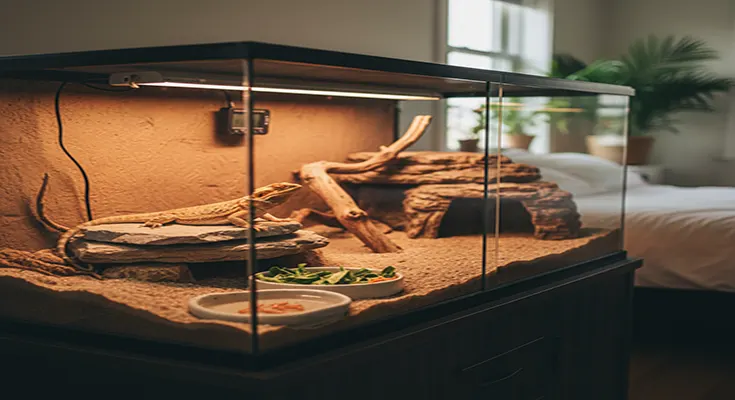
A bare tank is a stressful tank. Your dragon needs “furniture” to feel secure.
- Hides: You need at least two—one on the hot side and one on the cool side. This allows the dragon to hide while still choosing its temperature.
- Basking Platform: A flat rock or a sturdy piece of driftwood placed directly under the heat lamp.
- Climbing Branches: Bearded Dragons love to survey their kingdom from a height.
- Hammocks: Mesh hammocks are a fan favorite for lounging near the top of the tank.
Phase 6: Humidity and Hydration
Bearded Dragons are desert animals, but they aren’t cacti. They still need hydration.
- Humidity Levels: Aim for 20% to 40%. Too high, and they can develop respiratory infections; too low, and they will struggle to shed their skin.
- The Water Bowl: Provide a shallow dish of clean water. Note: Many dragons don’t recognize standing water. You may need to mist their greens or give them occasional “baths” in a plastic bin to ensure they stay hydrated.
The “Daily Maintenance” Checklist
To keep the blueprint running smoothly, follow this rhythm:
- Morning: Turn on lights (Heat and UVB). Offer fresh greens (collard greens, mustard greens, etc.).
- Afternoon: Offer live insects (dubia roaches or crickets) for 10–15 minutes. Remove uneaten insects so they don’t bite the dragon.
- Spot Clean: Remove any feces or uneaten salad immediately to prevent bacteria buildup.
- Evening: Turn off all lights. The tank should be completely dark and can drop to $18-21^{\circ}\text{C}$ ($65-70^{\circ}\text{F}$).
Summary Table: Habitat Specifications
| Component | Requirement |
| Enclosure | 120 Gallon (48x24x24) |
| Basking Temp | $38-42^{\circ}\text{C}$ |
| Cool Side Temp | $24-27^{\circ}\text{C}$ |
| UVB Type | T5 HO Linear Tube (10% or 12% output) |
| Photoperiod | 12 hours On / 12 hours Off |
| Humidity | 20% – 40% |
Building the perfect Bearded Dragon habitat is an investment of time and money, but it is the only way to ensure your “mini-dinosaur” lives a long, healthy life. By prioritizing the Heat Gradient and UVB Lighting, you are solving 90% of the health issues these animals face in captivity.
Once the ecosystem is balanced, you can stop worrying about the hardware and start enjoying the unique bond that comes with owning one of the world’s most charismatic reptiles.