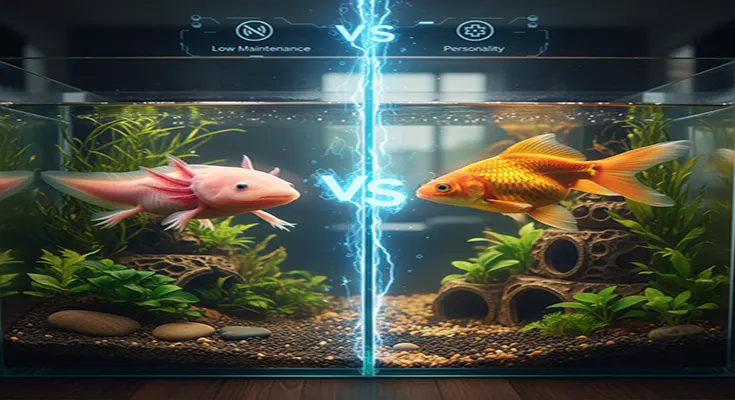
For decades, the “starter pet” for any aspiring aquatic hobbyist was the humble goldfish. They were the prizes of carnivals and the residents of millions of ceramic bowls. But in recent years, a new challenger has emerged from the ancient lakebeds of Mexico to conquer the internet: the Axolotl (Ambystoma mexicanum).
Thanks to their “smiling” faces, feathery external gills, and a starring role in Minecraft, axolotls have exploded in popularity. But as many new owners are discovering, these “Peter Pan” salamanders are not just “goldfish with legs.” Choosing between a traditional goldfish and an exotic axolotl is a decision that involves chemistry, biology, and a significant shift in lifestyle.
This is the ultimate showdown to see which aquatic companion belongs on your desk.
Round 1: Aesthetics and “The Viral Factor”
There is no denying that axolotls have a massive edge in the “cool” department. As neotenic salamanders, they stay in their larval form their entire lives, keeping their fringe-like gills and wide, alien eyes. They come in stunning “morphs,” including Leucistic (pink with black eyes), Golden Albino, and even “GFP” varieties that glow under blue light.
Goldfish, however, offer a classic, meditative beauty. From the flowing fins of a Comet to the quirky, bubbling cheeks of a Water Bubble Eye, goldfish provide a splash of vibrant orange and gold that can brighten any room.
- Winner: Axolotl, for sheer uniqueness and “Internet-famous” charm.
Round 2: Habitat and Water Chemistry (The Hard Truth)
This is where the two pets diverge sharply.
The Goldfish: Goldfish are “hardy,” but that is a bit of a myth. They are incredibly “dirty” fish, producing high amounts of ammonia. They require massive filtration and, contrary to popular belief, should never live in a bowl. A single fancy goldfish needs at least a 20-gallon tank to prevent stunted growth.
The Axolotl:
Axolotls are “cool water” specialists. While goldfish can tolerate a range of temperatures, axolotls must stay between $15-18^{\circ}\text{C}$ ($60-65^{\circ}\text{F}$). If your house gets warm in the summer, you will likely need an expensive aquarium chiller. Furthermore, they are sensitive to water flow; their delicate gills can be stressed by the powerful filters often used for goldfish.
- Winner: Goldfish, because they don’t require specialized cooling equipment (in most climates).
Round 3: Diet and Maintenance
If you hate “creepy crawlies,” the axolotl might not be for you.
- Goldfish: They are omnivores. High-quality flakes, pellets, and the occasional deshelled pea make up their diet. You can find their food at any grocery store.
- Axolotl: They are strict carnivores. Their diet consists of earthworms (nightcrawlers), bloodworms, and specialized sinking pellets. Feeding an axolotl often involves “tong-feeding,” as they have poor eyesight and hunt based on movement and smell.
In terms of cleaning, both require weekly water changes of about 20-30%. However, because axolotls lack scales, they are far more sensitive to water conditioners and chemicals than goldfish.
- Winner: Goldfish, for ease of feeding and lower chemical sensitivity.
Round 4: Longevity and Commitment
When you buy a pet, you are signing a contract for their entire life.
- Goldfish: A well-cared-for fancy goldfish lives 10 to 15 years, while common “feeder” types can live over 20 years.
- Axolotl: These salamanders typically live 10 to 15 years in captivity.
Both pets are long-term commitments, but the axolotl’s biological “magic”—their ability to regenerate lost limbs and even parts of their heart and brain—makes them a fascinating subject for lifelong study.
- Winner: Tie. Both require a decade-plus commitment.
Round 5: Social Needs and Tank Mates
Can they have friends?
- Goldfish: Extremely social. They thrive in groups and generally get along with other peaceful, cold-water fish.
- Axolotl: They are solitary and can be “nippy.” If you put two axolotls together, they may mistake each other’s gills or toes for food. Furthermore, you cannot keep fish with an axolotl. Fish will pick at the axolotl’s gills, and the axolotl will eventually try to eat the fish (often choking in the process).
- Winner: Goldfish, for those who want a bustling community tank.
Comparison Table: At a Glance
| Feature | Fancy Goldfish | Axolotl |
| Water Temp | Room Temp ($18-23^{\circ}\text{C}$) | Cold ($15-18^{\circ}\text{C}$) |
| Diet | Pellets, Flakes, Veggies | Live Worms, Sinking Pellets |
| Interactivity | Will “beg” for food; can be hand-fed. | Curious but slow; sensitive to touch. |
| Difficulty | Intermediate (due to waste) | Advanced (due to temp/chemistry) |
| Tank Size | 20+ Gallons | 29+ Gallons (Long) |
The Final Verdict
Choose a Goldfish if: You want a vibrant, social, and relatively low-tech aquarium. You enjoy the classic look of a planted tank and want a pet that is active during the day.
Choose an Axolotl if: You are a dedicated hobbyist willing to invest in a chiller and live food. You want a “conversation piece” pet that looks like it belongs in a sci-fi movie and you don’t mind a tank that stays relatively empty of other fish.
The axolotl isn’t a “better” pet than the goldfish; it is a different pet. The viral videos often fail to show the expensive chillers and the meticulous water testing required to keep those pink gills fluffy and healthy. But for the owner who puts in the work, the axolotl offers a prehistoric bond that no goldfish can replicate.